
How to avoid roaming charges abroad, and how two travelers got billed $78,240 and $143,442
At $15 per megabyte, one photo home costs $60. Neither traveler did anything unusual. Two settings stop it, and there are three places it still catches people who thought they were careful.
 Alexander J. Z.Sep 24, 20267 minute read
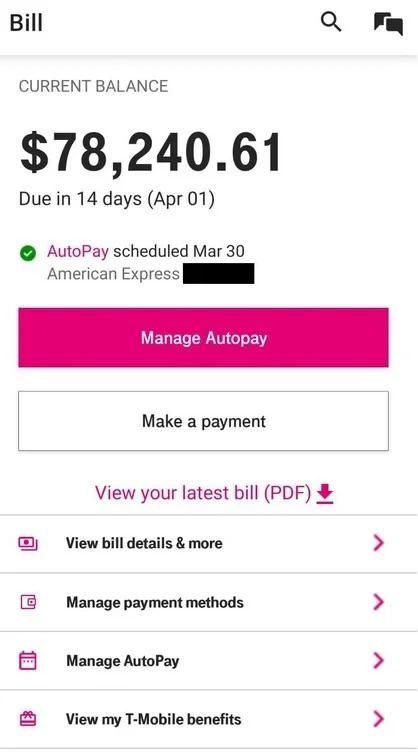
Turn off mobile data for your home line before you fly, and put your phone on a prepaid travel plan instead. That single step is the difference between a trip that costs what you expected and a bill with five figures in it. Two T-Mobile customers found that out in the same month last year, one of them to the tune of $78,240.61.
How a phone bill reaches $78,000
Not through anything unusual. Through arithmetic.
When a phone uses data abroad without an international plan attached, it falls back to a pay-per-use rate. T-Mobile's is $15 per megabyte, which works out to roughly $15,000 per gigabyte. Nothing about the phone looks different. There is no warning screen, no confirmation, no moment where anyone chooses to spend that money.
| What you did | Data | Cost at $15/MB |
|---|---|---|
Sent one photo home | 4 MB | $60 |
Looked up directions, ten minutes | 2 MB | $30 |
Checked a feed for five minutes | 60 MB | $900 |
Let photo backup run for one day | 400 MB | $6,000 |
An ordinary week of light use | 1 GB | $15,000 |
Nobody has those numbers in their head, and nothing on the phone puts them there. The meter simply runs.
The two cases, and what they actually show
The $78,240.61 bill that circulated on Reddit in August 2025 was a family coming home from vacation. No international plan on the line, and the pay-per-use rate applied.
Weeks later it happened again, worse. Rene Remund and his wife spent three weeks in Switzerland. He sent photos and messages to family, which is what phones are for, and used about 9.5 GB across the trip - an entirely ordinary amount for three weeks. The bill was $143,442.74.
Remund's case has a detail worth sitting with. Before the trip he called his operator to check he would be fine abroad, and was told he was covered. He was not. When the bill arrived and he queried it, a support representative reviewed it and told him it was correct. He got the charges cleared only after hiring a lawyer and going to the press, at which point the full amount was credited back.
Both cases were reported at the time by the phone press; sources are listed at the foot of this article.
The safeguard people assume exists - someone noticing that a domestic customer has somehow accrued a six-figure balance in three weeks - did not trigger. The system charged the rate it was configured to charge.
That is the real lesson, and it is not "roaming is expensive". It is that nothing in the chain is designed to stop this on your behalf.
Why "you're covered" is not an answer
The phrase hides a lot. Covered by what? A pass that has to be added before departure? A plan tier you may or may not be on? A daily charge that applies per line, or per account? A pass that covers some countries in a region but not the one you are actually going to?
Ask something narrower and harder to get wrong:
What is the rate per megabyte if I use data in that country without an international plan, and what exactly switches that rate off?
If the answer is vague, treat your home line as unsafe abroad and carry data another way. A vague answer is not reassurance; it is the same answer Remund got.
Six things to do before you fly
- Turn off mobile data for your home line, not just for individual apps. On iPhone this is under Cellular, on your primary line. On Android it is in SIM manager, where you choose which line handles data.
- Turn off the data-abroad setting for that line too. It is called Data Roaming on both iOS and Android, and it is the switch that lets your home operator bill you at its own rate.
- Put a travel data plan on the phone before you go, while you still have Wi-Fi. A prepaid plan cannot generate an overage, because there is no account to charge against. When it runs out it stops or slows, and that is the whole of it.
- Keep your home SIM in the phone for calls and texts. Bank codes and calls from people who do not message still need to reach you. It is data you are switching off, not the line.
- Turn off automatic photo backup on mobile data. In both cases above, ordinary photo and message traffic did the damage. It is the single largest unattended consumer on most phones.
- Check the phone after you arrive. Look at which line is carrying data before you start using it properly. Thirty seconds, once.
Three places this still catches careful people
Even with the settings right, there are three situations where the pay-per-use rate can reappear.
At sea and in the air. Ships and aircraft carry their own satellite-linked networks, and these sit outside almost every international pass and every travel data plan. They are billed separately and at maritime or aviation rates, which are high even by the standards of this article. On a ferry or a cruise, keep the phone on airplane mode unless you have bought that specific service.
Near a border. Phones register on the strongest tower, not the nearest one in your own country. Within a few kilometers of a land border your phone can sit on a foreign network for hours while you are still at home - and if your home line has data enabled, that is billed as if you had traveled.
On a second device. A tablet, a watch with its own connection, a travel router. People switch off data on the phone and forget the other thing in the bag, still on the home account, still syncing.
What to do if it has already happened
Do not pay it, and do not assume the first answer is final. Remund's bill was declared correct by his operator before it was written off in full.
- Put the dispute in writing. A phone call leaves you with nothing to point at later.
- Ask for an itemized breakdown by day and by line, not a total.
- Ask which international plan was on the account, and when it was applied. If the answer is "none", ask why no usage alert was sent.
- If you were told before the trip that you were covered, say so with the date of the call, and ask for that call to be retrieved.
- Escalate outside the support queue. Both of the bills above were reduced only after the customer went past the first line - one of them via a lawyer and the press.
In the US, the FCC accepts consumer complaints about billing and filing one costs nothing. In the EU and UK, the equivalent route runs through the national telecoms regulator and, where the operator is signed up to one, an alternative dispute resolution scheme. [CONFIRM: whether the blog gives US-specific procedural advice, given that the active market is Poland.]
Key facts
- Without an international plan, some US operators charge around $15 per megabyte abroad - roughly $15,000 per gigabyte.
- A reported $78,240.61 bill in August 2025, and $143,442.74 weeks later for three weeks and about 9.5 GB.
- Neither customer did anything unusual. Photos and messages were enough.
- One of them was told before the trip that he was covered, and told again afterwards that the bill was correct.
- Turning off mobile data and the data-abroad setting for your home line is the step that prevents it.
- Ships, aircraft and land borders can reintroduce the charge even when the settings are right.
- A prepaid travel plan cannot produce an overage, because there is no billing relationship to exceed.
- If you are billed at that rate, dispute it in writing and escalate past the first support reply.
Sources
- Phandroid, 28 August 2025 - This family's $78,000 T-Mobile data roaming bill should be a lesson for us all
- PhoneArena - Family using T-Mobile goes on overseas vacation, receives $78K monthly bill
- PhoneArena - This T-Mobile customer got a $143,442.74 bill after a three-week Switzerland vacation
The $15 per megabyte pay-per-use rate quoted above is T-Mobile's, as reported in the coverage listed. Rates differ by operator and change over time - check your own operator's current figure rather than assuming this one.